
Biogas composition: what gases it contains and why it is important to know them
The composition of biogas is one of the most important factors in determining its quality, energy value and potential uses. Although biogas is regarded as a renewable energy source with great potential, not all biogases have the same composition or offer the same performance.
The proportion of methane, carbon dioxide and other compounds present in the gas has a direct impact on the efficiency of engines, upgrading systems, biomethane plants and industrial processes.
Furthermore, the presence of contaminants such as hydrogen sulphide (H₂S) can cause corrosion problems and increase operating costs if not properly controlled.
In this article, we analyse the composition of biogas, the factors that affect it, and why it is essential to understand this in order to optimise a plant’s performance.
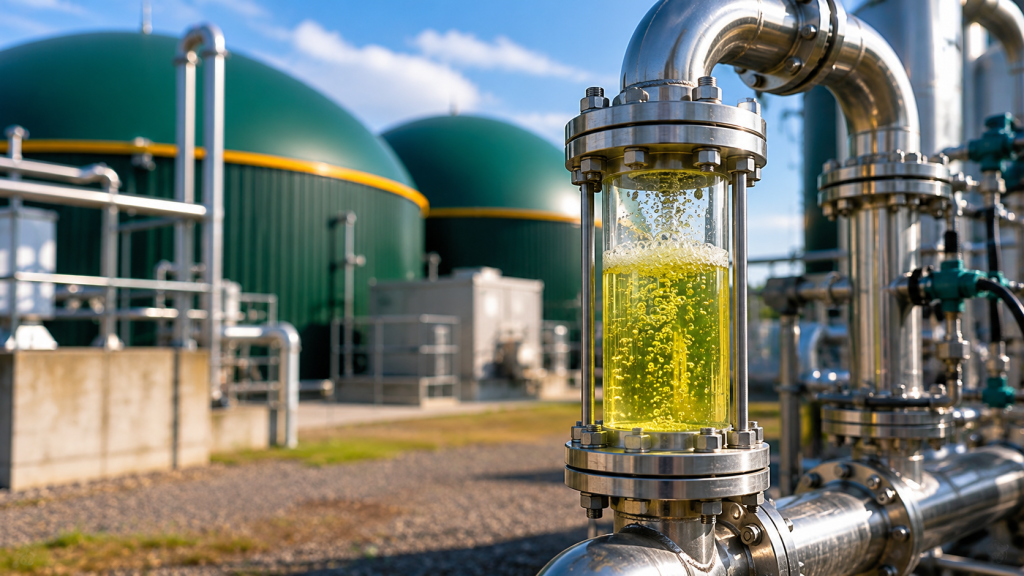
What is the composition of biogas?
Although the composition may vary from one plant to another, biogas is usually composed mainly of methane and carbon dioxide.
| Componente | Percentage approximate |
| Methane (CH₄) | 50 – 75 % |
| Carbon dioxide (CO₂) | 25 – 50 % |
| Water vapour (H₂O) | Variable |
| Hydrogen sulphide (H₂S) | Traces at thousands of ppm |
| Nitrogen (N₂) | < 5 % |
| Oxygen (O₂) | < 2 % |
| Other compounds | Traces |
The proportion of each component directly influences the energy content and quality of the biogas.
Methane (CH₄): the most important component
Methane is the main energy component of biogas.
The higher its concentration:
- The higher the calorific value
- Energy production will be more efficient
- The better the quality of the gas, the better
Generally speaking, plants aim to maximise methane production by optimising the anaerobic digestion process.
Carbon dioxide (CO₂)
Carbon dioxide is the second most abundant component of biogas.
Although it does not provide any energy, it forms part of the biological process and must be removed when biomethane is to be produced.
During the upgrading process, a large proportion of the CO₂ is separated to produce a gas with properties similar to those of natural gas.
Hydrogen sulphide (H₂S)
Hydrogen sulphide is one of the most problematic pollutants found in biogas.
Its concentration depends on the sulphur content of the waste used and on the process conditions.
H₂S can cause:
- Corrosion of engines and pipes
- Formation of sulphuric acid
- Security issues
- Increase in operating costs
For this reason, desulphurisation is an essential stage in the majority of facilities. Due to its high corrosive potential, it is essential to control and eliminate this pollutant. In this article we explain what H₂S is, its risks and how to remove it in biogas plants .
Water vapour and humidity
Biogas is usually saturated with moisture as a result of the biological process itself.
The presence of water vapour can promote:
- Corrosion
- Condensate formation
- Engine problems
- Reduction in efficiency
For this reason, drying systems are a standard part of biogas processing.
Factors that influence the composition of biogas
The composition of biogas is not fixed and may vary depending on various factors.
Type of substrate
The waste used has a direct impact on:
- Methane production
- Generation of H₂S
- Final quality of the biogas
Digester temperature
Thermal stability promotes more efficient digestion and a more consistent gas yield.
Residence time
Allowing sufficient time enables organic matter to break down more completely.
Biological conditions
Microbiological balance is essential for maximising methane production and minimising operational problems.
Why is it important to know the composition of biogas?
Analysing the composition of biogas makes it possible to:
- Assess your energy efficiency
- Designing suitable treatment systems
- Optimising biomethane production
- Reduce operating costs
- Protecting engines and equipment
- Complying with regulatory requirements
Regular monitoring is a key tool for maximising the performance of facilities.
How to improve the quality of biogas
Once the composition is known, it is possible to implement measures to improve the quality of the gas.
Reducing H₂S
The removal of hydrogen sulphide is one of the most important steps in improving biogas.
Technologies currently in the spotlight include:
- Iron hydroxides
- Iron oxides
- Activated carbon
- Biological systems
Solutions based on iron hydroxides for removing H₂S from biogas are notable for their high efficiency and ability to reduce corrosion problems.
Monitoring H₂S
Knowing the actual concentration of hydrogen sulphide enables treatment systems to be optimised.
Biogas composition and biomethane production
The production of biomethane requires a much higher standard of gas quality.
To do this, you need to:
- Remove H₂S
- Reducing CO₂
- Remove moisture
- Comply with technical specifications
The better the initial quality of the biogas, the more efficient the upgrading process will be.
CONCLUSION
The composition of biogas is a aspect that is fundamental to determining its quality, energy value and potential for utilisation.
Although methane is the most important component from an energy perspective, it is also essential to monitor pollutants such as H₂S and other compounds that may affect the performance of the facilities.
Understanding the composition of biogas enables optimisation of the treatment < a9> treatment, improve the production of biomethane and maximise the profitability of the plants.
At Nalón Minerals, we develop innovative solutions for biogas desulphurisation, tailored to the specific needs of each industrial facility.
Frequently asked questions about the composition of biogas
What is the composition of biogas?
Biogas consists mainly of methane (CH₄) and carbon dioxide (CO₂), as well as small amounts of H₂S, water vapour, nitrogen and other compounds.
What percentage of methane is there in biogas?
Typically between 50 per cent and 75 per cent, depending on the substrate and the process conditions.
Why is it important to remove H₂S from biogas?
Because hydrogen sulphide causes corrosion and damage to engines and industrial equipment.
How can the quality of biogas be improved?
By removing pollutants, controlling H₂S and optimising the anaerobic digestion process.